
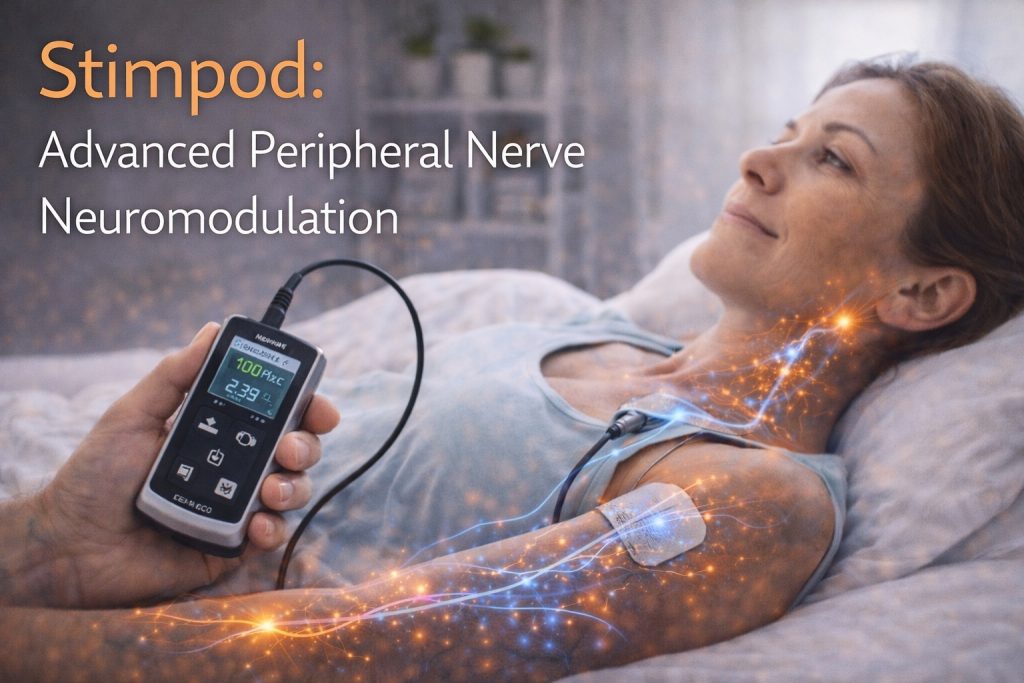
Stimpod: Advanced Peripheral Nerve Neuromodulation
At the Robert McDonald Clinic, we use the Stimpod—a state-of-the-art non-invasive radiofrequency (PRF) device—to treat chronic, therapy-resistant nerve pain. This technology allows us to precisely locate “short-circuited” nerves and apply a corrective signal to restore normal function.
The Science: How the Stimpod Works
The Stimpod utilizes a patented Symmetrically Biphasic Waveform to communicate with the peripheral nervous system.
- Nerve Mapping: Using a specialized probe, we scan the surface of the skin to find the exact location of a damaged or compressed nerve. When the probe passes over the affected nerve, it triggers a visible, rhythmic muscle response, allowing us to “see” exactly where the nerve is stuck.
- Pulsed Radiofrequency (PRF): Unlike traditional TENS units that just “mask” pain, the Stimpod creates an electromagnetic field that travels along the nerve. This helps “repolarize” the nerve membrane, effectively turning down the “volume” of chronic pain signals.
- Restoring Nerve Glide: By stimulating the nerve and its surrounding muscle, the Stimpod helps release the nerve from “entrapments” or scar tissue that may be causing numbness, tingling, or burning.
Clinical Applications: What We Treat
The Stimpod is specifically effective for conditions where the nerve itself is the source of the problem:
- Neuropathy: Relief for the burning, tingling, and numbness associated with diabetic or idiopathic neuropathy.
- Sciatica & Radiculopathy: Pinpointing exactly where a nerve root is compressed in the lower back or neck.
- Bell’s Palsy & Facial Pain: Helping to “re-awaken” facial nerves and muscles during recovery.
- Chronic Joint Pain: Treating the “sensitized” nerves around a joint that remain painful even after the physical injury has healed.
- Carpal Tunnel & Morton’s Neuroma: Non-invasive decompression of the nerves in the wrist and foot.
The Stimpod Advantage
- Instant Feedback: The Stimpod gives us real-time diagnostic information. If the muscle doesn’t twitch where it should, we know the nerve conduction is impaired.
- Non-Invasive: It provides the benefits of nerve-block injections or radiofrequency ablation without the use of needles or surgery.
- Long-Lasting Relief: Many patients experience a significant reduction in nerve pain after just 3–5 sessions, as the treatment helps the nerve return to its healthy, “resting” state.