
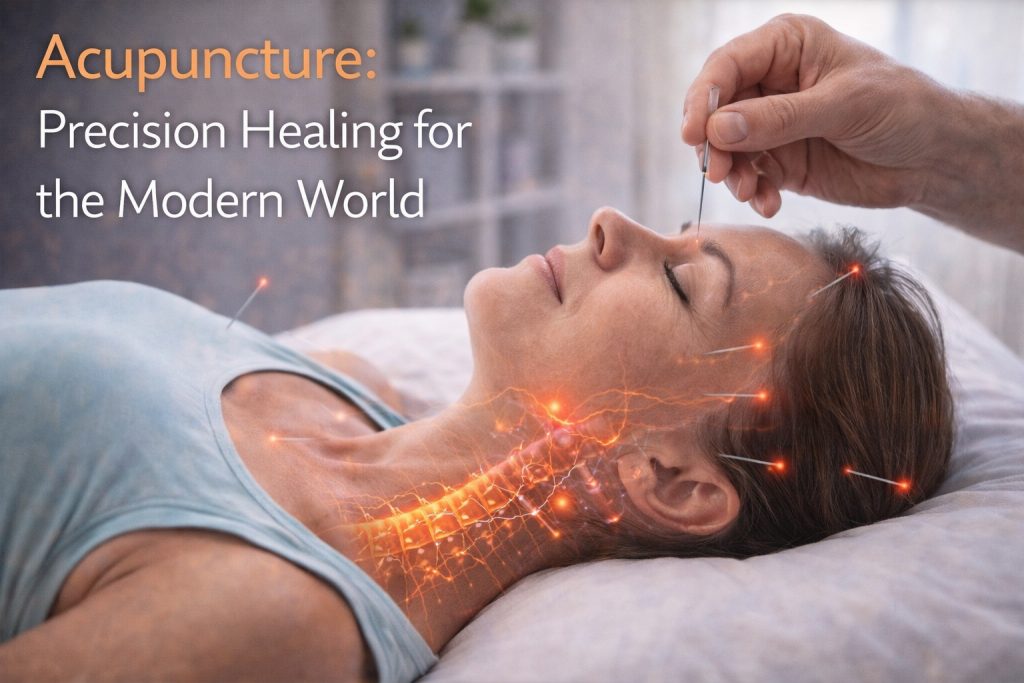
Acupuncture: Precision Healing for the Modern World
At the Robert McDonald Clinic, we bridge the gap between ancient therapeutic wisdom and 21st-century clinical science. While acupuncture has been a cornerstone of health for millennia, modern research now allows us to understand exactly how this practice helps the body heal itself.
The Science of How It Works
Modern neuroimaging (fMRI) and biochemical studies have revealed that acupuncture is more than just “balancing energy.” It is a sophisticated method of neuromodulation.
- Nervous System Regulation: Acupuncture needles stimulate sensory nerves under the skin and in the muscles.This triggers the brain to release natural pain-relievers, including endorphins, enkephalins, and serotonin.
- Reducing Inflammation: Recent 2024-2025 studies show that acupuncture can lower systemic inflammation by regulating the body’s cytokine response and calming the “fightor-flight” (sympathetic) nervous system.
- Neuroplasticity: Research in 2025 indicates that consistent acupuncture can actually help “rewire” pain pathways in the brain, providing long-term relief for chronic sufferers rather than just a temporary fix.
Joint & Skeletal Mobilization
We believe in evidence-based care. Here is what the latest global research says about acupuncture’s efficacy:
- Chronic Pain: A major meta-analysis involving over 20,000 patients confirmed that acupuncture is significantly superior to standard care for back and neck pain, osteoarthritis, and shoulder pain, with effects persisting for 12 months or longer.
- Migraines & Headaches: Clinical trials updated in 2025 found that acupuncture reduces the frequency of migraine attacks by modulating CGRP (calcitonin gene-related peptide), a key protein involved in the transmission of pain.
- First-Line Treatment: The American College of Physicians now officially recommends acupuncture as a first-line, non-pharmacological treatment for acute and chronic low-back pain.
The 2025 Perspective: Emerging research in Bioelectronic Medicine treats acupuncture points as “access nodes” to the nervous system. By stimulating these nodes, we can send signals to the brain to down-regulate systemic inflammation—a breakthrough for treating autoimmune-related discomfort.
What We Treat
| PAIN MANAGEMENT | NEUROLOGICAL & MOOD | WELLNESS & INTERNAL |
| Sciatica & Lower Back Pain | Chronic Migraines | Stress & Anxiety Relief |
| Sports & Muscle Injuries | Tension Headaches | Digestive Harmony (IBS) |
| Osteoarthritis | Insomnia & Sleep Disorders | Immune System Support |
Comprehensive Scope of Acupuncture Treatment
Musculoskeletal & Chronic Pain
This is the most researched area of acupuncture, often used as an alternative to opioid or NSAID medications.
- Back & Neck Pain: Sciatica, degenerative disc disease, and chronic strain.
- Joint Pain: Osteoarthritis of the knee, hip, and shoulder.
- Headaches: Chronic migraines, tension-type headaches, and cluster headaches.
- Repetitive Stress: Carpal tunnel syndrome, tennis elbow (lateral epicondylitis), and tendonitis.
- Fibromyalgia: Managing widespread muscle pain and associated fatigue.
Neurological & Mental Health
Acupuncture’s ability to modulate the Autonomic Nervous System makes it a powerful tool for neurological and emotional balance.
- Stress & Anxiety: Reducing cortisol levels and inducing a “parasympathetic” (rest and digest) state.
- Insomnia: Regulating melatonin and serotonin production for deeper sleep.
- Post-Stroke Rehabilitation: Assisting in motor function recovery and speech therapy.
- Bell’s Palsy: Stimulating facial nerve recovery in the acute phase.
- Depression: Often used as an adjunct therapy to improve the efficacy of traditional treatments.
Digestive & Metabolic Health
By stimulating the Vagus nerve and regulating gut motility, acupuncture addresses various GI issues.
- Irritable Bowel Syndrome (IBS): Reducing cramping, bloating, and irregular movements.
- Acid Reflux (GERD): Balancing stomach acid and esophageal function.
- Nausea: Highly effective for chemotherapy-induced nausea and morning sickness.
- Weight Management: Assisting in appetite suppression and metabolic regulation (as part of a holistic plan).
Respiratory & Immune Support
- Allergic Rhinitis: Reducing the body’s inflammatory response to pollen and dust.
- Chronic Sinusitis: Improving drainage and reducing sinus pressure.
- Asthma Support: Helping to relax the bronchial tubes (as a complementary therapy).
- Immune Modulation: Increasing white blood cell counts and enhancing the body’s defense mechanisms.
Reproductive & Hormonal Health
- Fertility Support: Improving blood flow to the reproductive organs and regulating cycles (often used alongside IVF).
- Menstrual Health: Treating PMS, painful periods (dysmenorrhea), and PCOS symptoms.
- Menopause: Reducing the frequency and severity of hot flashes and night sweats.
Your Experience at the Clinic
Modern acupuncture is gentle, safe, and profoundly relaxing.
- Comprehensive Assessment: We look at your medical history, lifestyle, and specific pain points.
- Personalized Plan: We create a treatment protocol tailored to your unique biology and goals.
- The Treatment: Using ultra-fine, sterile, single-use needles, we target specific neuroanatomical points. Most patients feel a sense of heavy relaxation or a light “tingle”— many even fall asleep during the session.
- Integrated Care: We often combine acupuncture with other modalities to accelerate your recovery.
Did You Know? Most insurance plans now cover acupuncture for chronic pain management. Check with your provider to see how your benefits can support your healing journey.
In a modern clinical setting, patients often don’t realize that “Acupuncture” isn’t a single technique, but a diverse family of traditions. For your website, comparing the Chinese (TCM) and Japanese styles demonstrates your breadth of expertise and helps patients choose the approach that best fits their comfort level.
East Asian Traditions: Chinese vs. Japanese Acupuncture
While both systems use the same meridian maps and “points,” their clinical application feels quite different. At the Robert McDonald Clinic, we integrate the strength of both traditions to provide a personalized experience.
| FEATURE | TRADITIONAL CHINESE MEDICINE | JAPANESE STYLE (MERIDIAN THERAPY) |
| Needle Gauge | Thicker needles for stronger stimulation. | Ultra-thin needles (often as thin as a hair). |
| Sensation | Focused on De Qi (a heavy, dull, or achy sensation). | Focused on subtle, painless, or “feather-touch” contact. |
| Insertion Depth | Generally deeper (5 mm to several centimeters). | Very shallow; sometimes the needle only touches the skin. |
| Primary Diagnosis | Looking at the tongue and feeling the pulse. | Extensive abdominal palpation (Hara diagnosis) and pulse. |
| Treatment Goal | To “clear” blockages and move energy. | To “tonify” and gently restore the body’s balance. |
Traditional Chinese Medicine (TCM): The “Standard” Goal stagnant energy, body’s vital reserves.
TCM is the most common form of acupuncture practiced globally. It is a robust, “active” style of treatment.
- The “De Qi” Sensation: In TCM, the practitioner looks for a specific sensation called De Qi. This is often described by patients as a heavy, spreading, or “electric” feeling. In modern neurological terms, this indicates the needle has successfully reached the “Adelta” or “C-fiber” nerves to trigger a brain response.
- Strong Results for Acute Pain: Because of the deeper insertion and stronger stimulation, TCM is often the preferred choice for heavy musculoskeletal issues, such as deep lower back pain or frozen shoulder.
Japanese Acupuncture: The “Gentle” Tradition
Japanese acupuncture evolved to be more subtle and refined, partly due to a historical tradition of blind acupuncturists in Japan who developed an incredibly sensitive “touch” and “feel” for the skin.
Palpation-Based: Before any needles are used, the practitioner will gently press on your abdomen (the Hara) or along your meridians. We look for “live” points—areas that feel tight or cold—to determine exactly where the body is out of balance.
- The Use of “Guide Tubes”: The invention of the guide tube in Japan allowed for much thinner needles to be inserted painlessly. This makes it the ideal choice for children, the elderly, or anyone who is sensitive to needles.
- Non-Insertive Techniques: In some Japanese styles, we use tools like the Teishin (a nonpiercing needle) to touch the surface of the skin. This is remarkably effective for calming the nervous system and treating pediatric conditions.
Which Style is Right for You?
- Chinese Style: If you prefer a “hands-on,” stronger sensation, have deep-seated physical pain, or have a robust constitution that responds well to direct stimulation.
- Japanese Style: If you are sensitive to needles, prefer a very relaxing and quiet treatment, or are dealing with chronic fatigue, autoimmune issues, or emotional stress where a “less is more” approach is required.
Our Integrated Approach
At the Robert McDonald Clinic, we don’t believe you have to choose just one. We often use
Japanese techniques to calm your nervous system and “open” the meridians, followed by Chinese or Auricular techniques to target specific areas of pain. This “hybrid” method ensures maximum results with minimum discomfort.
Electro-Acupuncture: The Science of Precision Neuromodulation
Electro-acupuncture is the clinical application of a small, pulsating electrical current to acupuncture needles. This technique allows us to communicate directly with the nervous system using specific frequencies to “tune” the body’s healing response.
The Science: How It Works
When we add electricity to the needle, we are essentially amplifying the signal to the brain.
- Frequency Specificity: We use different frequencies (measured in Hertz) to achieve different biological outcomes.
- Low Frequency (2–4 Hz): Triggers the release of enkephalins and endorphins, providing long-lasting systemic pain relief.
- High Frequency (50–100 Hz): Triggers dynorphins, which are powerful for immediate, localized pain suppression and reducing acute inflammation.
- Motor Point Stimulation: In musculoskeletal cases, EA is used to “reset” dysfunctional muscles. The current causes the muscle to twitch (fasciculation), which overrides the “pain-spasm-pain” cycle and restores normal muscle tone.
- Endogenous Opioid Release: Research confirms that EA stimulates the hypothalamus and pituitary gland to release the body’s own natural “pharmacy” of pain-killing chemicals.
Modern Research & Clinical Evidence
Electro-acupuncture is at the forefront of “Bioelectronic Medicine.” Recent studies (2024-2025) have highlighted its efficacy in several key areas:
- The Vagus Nerve & Cytokine Storms: Breakthrough research has shown that specific electro-acupuncture stimulation at the “Zusanli” (ST36) point can activate the Vagus nerve, which in turn tells the spleen to stop producing pro-inflammatory cytokines. This makes EA a potent tool for treating systemic inflammatory conditions.
- Nerve Regeneration: Studies in neurobiology suggest that low-frequency EA can promote the expression of nerve growth factors (NGF), assisting in the recovery of peripheral nerve injuries and neuropathy.
- Chronic Knee Osteoarthritis: A major clinical trial published in JAMA found that patients receiving electro-acupuncture experienced significantly more pain relief and improved physical function than those receiving manual acupuncture or “sham” treatments.
The Benefits: Why Choose Electro-Acupuncture?
While manual acupuncture is excellent for many conditions, EA offers unique advantages for specific cases:
- Consistent Stimulation: Manual needling requires the practitioner to constantly manipulate the needle to maintain the signal. EA provides a steady, measurable, and consistent stimulus for the duration of the treatment.
- Deeper Tissue Reach: The current can bridge the gap between two needles, creating a “field” of stimulation that reaches deeper nerves and tissues than a single needle could.
- Superior for Neurological Issues: It is the gold standard for treating sciatica, Bell’s Palsy, post-stroke motor recovery, and chronic neuropathy.
- Reduced Treatment Time: Because the stimulation is more intense, we can often achieve significant physiological changes in a shorter window of time.
What Does It Feel Like?
Patients often find electro-acupuncture to be a very pleasant experience.
- The Sensation: You will feel a gentle “tapping,” “pulsing,” or “tingling” sensation. It should never feel sharp or painful.
- The “Twitch”: If we are treating a muscle injury, you may see the muscle move slightly. This is a sign that the motor nerve is being successfully “reset.”
- Post-Treatment: Most patients leave feeling a deep sense of relaxation and a significant “heaviness” in the treated area as the nervous system enters a recovery state.
Acupuncture FAQs
Does it hurt?
Most patients feel only a slight tingle or a sense of relaxation. The needles are ultra-fine, much smaller than a standard medical needle.
How many sessions will I need?
This depends on your condition. Acute issues may resolve in 3–5 sessions, while chronic conditions might require a longer course of treatment.
Is it safe?
Yes. We use sterile, single-use, disposable needles in a clean clinical environment.
How should I prepare?
Wear loose clothing and ensure you have eaten a light meal or snack before your appointment.