
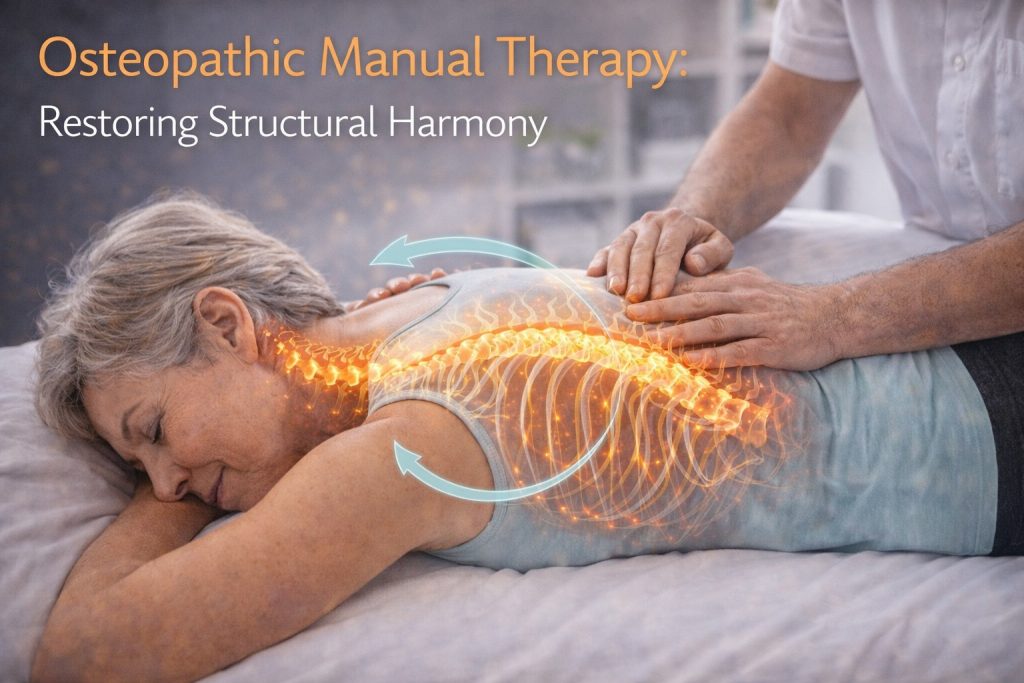
Osteopathic Manual Therapy: Restoring Structural Harmony
Osteopathy is a form of drug-free, non-invasive manual therapy that focuses on total body health by treating and strengthening the musculoskeletal framework. At the Robert McDonald Clinic, our approach is rooted in the principle that the body is an integrated and indivisible whole.
Osteopathic Manual Therapy: Restoring Structural Harmony
Osteopathy is a form of drug-free, non-invasive manual therapy that focuses on total body health by treating and strengthening the musculoskeletal framework. At the Robert McDonald Clinic, our approach is rooted in the principle that the body is an integrated and indivisible whole.
The “Mechanical” Science of Osteopathy
Unlike treatments that focus solely on the site of pain, Osteopathic Manual Therapy (OMT) looks for the root cause. If your knee hurts, we examine your hip, your pelvis, and your gait.
- Bio-Mechanical Alignment: We use manual techniques to influence the joints, muscles, and ligaments. By improving structural alignment, we reduce the “mechanical stress” that leads to chronic wear and tear.
- The Rule of the Artery: A core osteopathic tenet is that healthy blood flow is essential for healing. Manual manipulation helps release myofascial restrictions that may be impeding circulation and lymphatic drainage.
- Proprioceptive Reset: Research shows that manual stretching and mobilization “reset” the nervous system’s feedback loop, reducing muscle guarding and increasing range of motion.
Clinical Research & Evidence
Osteopathy is increasingly recognized in clinical guidelines for its effectiveness in musculoskeletal rehabilitation:
- Lower Back Pain: Large-scale systematic reviews (including studies updated in 2025) consistently show that Osteopathic Manual Treatment significantly reduces pain and improves functional status in patients with acute and chronic non-specific low back pain.
- Cervicogenic Headaches: Clinical evidence supports OMT as an effective intervention for headaches originating from the neck, often providing a safer alternative to long-term NSAID use.
- Autonomic Impact: Recent studies in manual medicine suggest that suboccipital decompression (a common osteopathic technique) can positively influence the Vagus nerve, helping to shift the body from a “stressed” state to a “recovery” state.
Our Manual Techniques
We utilize a variety of specialized “hands-on” methods depending on your body’s needs:
The Osteopathic Toolkit: Advanced Manual Techniques
Osteopathy is unique because it utilizes both Direct techniques (moving toward the restriction) and Indirect techniques (moving away from the tension to allow the body to reset). Below is a comprehensive look at the methods we use to restore function.
Soft Tissue & Myofascial Techniques
These focus on the “sheath” that surrounds every muscle and organ in your body.
- Soft Tissue Massage (STM): Different from a spa massage, this involves deep tissue pressure, rhythmic stretching, and traction to move fluids and relax hypertonic muscles.
- Myofascial Release (MFR): A sustained, gentle pressure used to eliminate pain and restore motion in the connective tissue (fascia).
- Direct MFR: Stretching the fascia directly.
- Indirect MFR: Following the tissue into the “path of least resistance” until a release is felt.
Joint & Skeletal Mobilization
These techniques aim to restore the natural “glide” and range of motion to your joints.
- Articulation (Mobilization): A rhythmic, low-velocity technique where the osteopath moves a joint through its natural range of motion to increase lubrication and flexibility.
- Muscle Energy Technique (MET): A “functional” technique where the patient provides a specific, gentle muscle contraction against the practitioner’s resistance. This uses the body’s own neuromuscular signals to lengthen tight muscles and reposition joints.
Specialized Osteopathic Systems
These represent the “Whole-Body” philosophy of the Robert McDonald Clinic.
- Visceral Manipulation (VM): This involves gentle manual forces applied to the internal organs (viscera) and their attachments. Restrictions in the liver, stomach, or intestines can often manifest as referred pain in the back or neck.
- Craniosacral Therapy (CST): A very subtle, light-touch approach that focuses on the bones of the skull, the spine, and the sacrum. It aims to optimize the flow of cerebrospinal fluid and calm the central nervous system.
- Strain-Counterstrain (Positional Release): An indirect technique where the practitioner finds a “tender point” and places the patient’s body in a position of maximum comfort for 90 seconds. This “tricks” the nervous system into releasing a chronic muscle spasm.
Fluid & Circulatory Techniques
- Lymphatic Pumps: Manual techniques designed to help the body’s lymphatic system drain waste and reduce edema (swelling). This is particularly effective for boosting the immune system or recovering from surgery.
- Balanced Ligamentous Tension (BLT): The practitioner finds a “point of balance” in a joint’s ligaments, allowing the body’s inherent self-healing mechanisms to resolve the tension.
Which Technique is Right for You?
We don’t choose a technique based on a manual; we choose it based on you.
- For Acute Injuries: We often use “Indirect” techniques (like Counterstrain) to avoid aggravating inflamed tissue.
- For Chronic Stiffness: We might use “Direct” techniques MET or Articulation to break up long-standing restrictions.
- For Stress-Related Tension: We often incorporate Craniosacral or Visceral work to address the autonomic nervous system.
| TECHNIQUE | HOW IT WORKS | BEST FOR |
| Sofe Tissue Deformity | Deep pressure and stretching of the muscle | Circulation & Muscle tension |
| Muscle Engergy Technique (MET) | You move your muscles in a specifie direction | Joint fange of Motion |
| Myofascial Release | Constant, Gentle pressure to release restriction | Chronic pain & Posture |
| Articulatory Techniques | Phythmic, passive moving of the joints | Stiffness & Arthritis |
Why Choose Osteopathy?
Patients today are moving away from “symptom-masking” and toward functional longevity. Osteopathy is ideal for:
- Postural Correction: Reversing the “tech-neck” and slumped shoulders caused by modern desk work.
- Injury Prevention: Identifying “silent” imbalances before they turn into acute injuries.
- Chronic Condition Management: Providing gentle relief for those with degenerative disc disease or fibromyalgia.
What to Expect
Your session is a collaborative process. We don’t just “apply” a treatment; we perform a functional movement screen to see how your body breathes, walks, and rotates. The goal is to leave the clinic feeling “lighter,” more aligned, and equipped with the knowledge to maintain those gains at home.
Osteopathy FAQ
What is the difference between Osteopathy and Chiropractic?
While both treat the spine, Osteopaths focus on the whole body, including soft tissues, fascia, and internal organs, using a broader range of manual techniques.
Will there be "cracking"?
We use many varied techniques which are typically gentle. Osteopathy involves rhythmic mobilization and myofascial release where there is generally not a “cracking” sound.
Can I come in if I'm in acute pain?
Yes. We have gentle “indirect” techniques specifically designed to reduce inflammation and pain without aggravating the injury.
What should I wear?
Please wear comfortable, flexible clothing (like gym wear) as we will be moving your limbs and assessing your posture.