
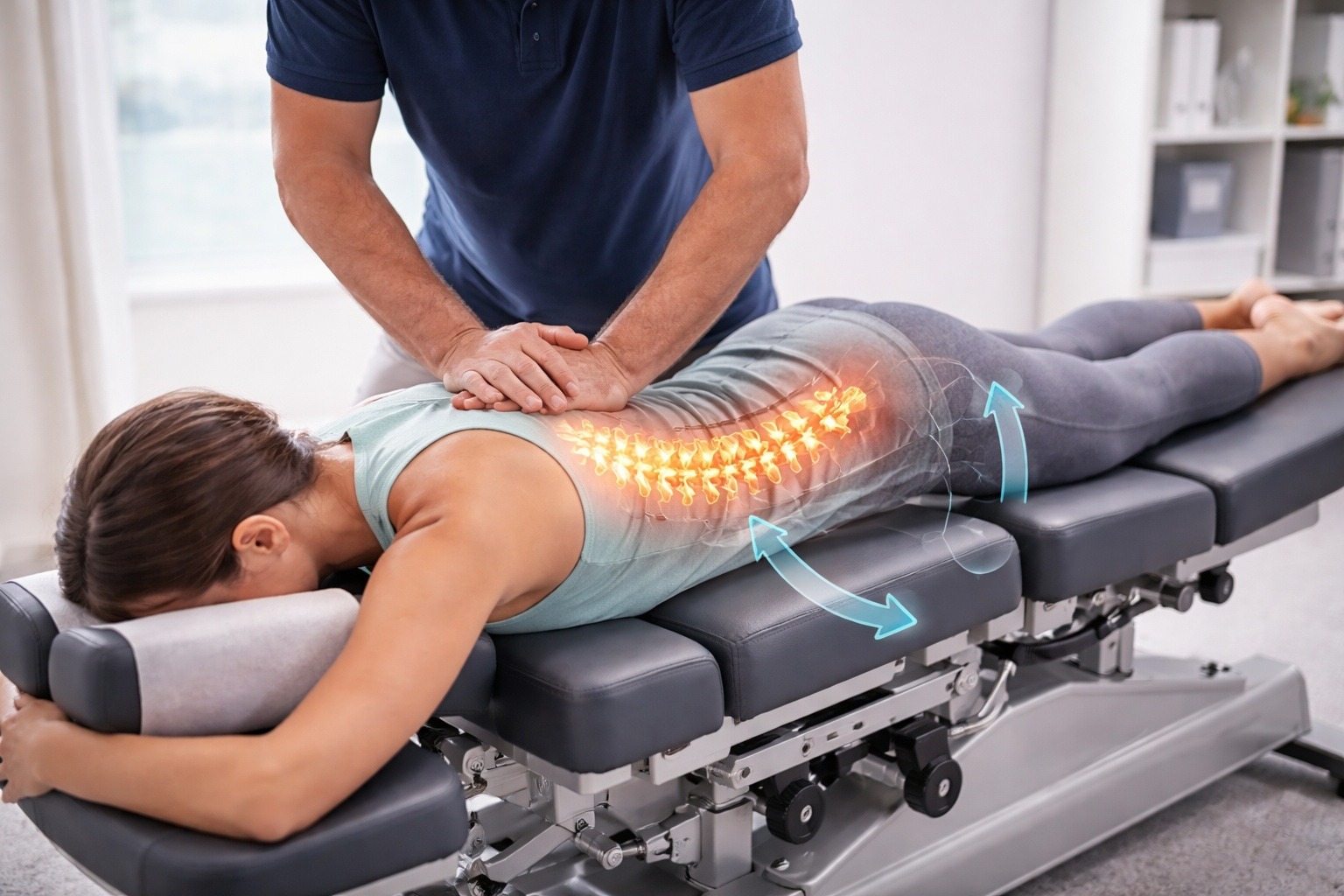
Flexion-Distraction
At the Robert McDonald Clinic, we utilize flexion-distraction to perform precision spinal decompression. This specialized treatment is a gentle, non-surgical procedure designed to resolve lower back and neck pain by increasing the space between your vertebrae and reducing pressure on your spinal nerves.
The Science: How Flexion-Distraction Works
Flexion-Distraction is a slow, rhythmic movement that uses gravity and the table’s mechanical design to mobilize the spine.
- Intradiscal Pressure Reduction: Research shows that this technique can drop the pressure inside a spinal disc to as low as -192mm Hg. This creates a “vacuum effect” that helps pull a bulging or herniated disc back into its proper place.
- Increasing the Foraminal Opening: The gentle stretching increases the height of the intervertebral disc space by up to 28%, giving pinched nerves the room they need to heal.
- Restoring Joint Mobility: By moving the spine through its natural range of motion without a high-velocity “crack,” we can safely restore movement to stiff, arthritic joints.
Why use a Flexion Distraction Table?
The Treatment table is engineered to allow the practitioner to move your spine in three dimensions: Flexion (bending forward), Extension (backward), and Lateral Flexion (side-to-side).
- Patient-Controlled Comfort: The table is designed to be comfortable for patients in acute pain who cannot lie flat on a standard table.
- Targeted Decompression: Because the table is segmented, we can isolate the specific vertebrae that are causing your pain, rather than stretching the entire spine at once.
Clinical Applications: What We Treat
The Cox Technic on the Flexion Distraction table is specifically indicated for complex spinal conditions:
- Disc Herniations & Bulges: The primary choice for avoiding surgery.
- Spinal Stenosis: Providing relief by opening up the spinal canal.
- Spondylolisthesis: Safely managing vertebrae that have shifted out of alignment.
- Sciatica: Decompressing the nerve root at the source in the lumbar spine.
- Chronic Facet Syndrome: Restoring motion to the small joints of the spine that have become inflamed.
The Research on Flexion Distraction
Flexion Distraction techniques are highly studied in the field of Manual Therapy, backed by millions of dollars in federally funded research (NIH/HRSA)
- Success Rates: Studies show that 91% of patients reach maximum improvement within 90 days, with many experiencing relief in significantly less time.
- Surgical Prevention: It is often the final step for patients who have been told they are “surgical candidates” but want to try a conservative, evidence-based approach first.
What Does It Feel Like?
- The Sensation: Patients often describe the treatment as a “deep, relaxing stretch.” There is no sudden popping or twisting of the spine.
- The Movement: You will feel the lower half of the table gently drop and rise in a rhythmic motion. Many patients find the process so soothing that they become deeply relaxed during the session.
- Post-Treatment: You may feel “taller” or “lighter,” with an immediate improvement in your ability to bend and move.